Customer Experience Benchmarking helps businesses compare their customer experience performance against a defined baseline, previous results, different locations, or internal targets. Instead of asking only whether customers are satisfied, benchmarking asks a more useful question: Is performance improving, declining, or staying consistent?
For businesses in Pakistan, this can be particularly useful when customer experience varies between branches, teams, service periods, or customer touchpoints. A single rating may show that something changed, but a benchmark can provide the context needed to understand whether the change is meaningful.
What Is Customer Experience Benchmarking?
Customer Experience Benchmarking is the process of measuring customer experience performance against a consistent reference point.
That reference point can be:
Previous business performance
A specific location or branch
Another department
An internal performance target
A defined service standard
A competitor benchmark, when reliable data is available
The objective is not simply to produce a higher score. Effective benchmarking helps businesses identify meaningful differences and decide where further investigation is needed.
Why Does Benchmarking Matter?
Customer experience can change gradually, making issues easy to miss in individual reviews. Benchmarking provides a reference point to track meaningful changes over time.
It helps businesses identify:
Changes in customer sentiment
Rating consistency
Underperforming locations
Rising negative reviews
Changes in customer engagement
Impact of process changes
Results after corrective actions
This turns CX measurement into an ongoing improvement process.
Which Customer Experience Metrics Should Businesses Benchmark?
There is no universal list of metrics that works for every business. The right metrics depend on the customer journey and the decisions a business needs to make.
Useful areas to monitor include:
Review Volume
Review volume can show how much public customer response a business is receiving.
However, volume alone does not indicate whether customer experience is improving. A higher number of reviews can contain both positive and negative signals.
Ratings
Average ratings provide a simple performance indicator, but businesses should avoid relying on the average alone.
A small change in average rating may mean something different depending on review volume, timing, location, and sentiment.
Sentiment
Sentiment can provide additional context around customer opinions.
A business may maintain a similar rating while the topics mentioned in reviews change. Sentiment analysis can help identify whether conversations are becoming more positive, negative, or mixed.
Feedback Response and Engagement
Businesses should also consider how customers interact with feedback requests and review processes.
Depending on the business, useful signals may include:
Response rates
Review engagement
Feedback participation
Changes in customer response patterns
Engagement with review requests
These metrics can help businesses evaluate whether their customer experience measurement process is producing useful input.
Negative Review Trends
Negative reviews deserve attention beyond their individual ratings.
Look for recurring themes, such as:
Waiting times
Staff interactions
Product availability
Service consistency
Communication problems
Billing or transaction concerns
The important question is not simply how many negative reviews exist. It is whether the same problem keeps appearing.
How Should Businesses Set a Customer Experience Baseline?
A useful benchmark starts with a reliable baseline using consistent periods and comparable data.
Businesses can compare:
This quarter vs. the previous quarter
One branch vs. the overall average
Departments against each other
Current vs. historical sentiment
Review trends before and after a process change
Avoid changing measurement methods mid-period, as this can make results difficult to interpret.
Expert insight: A good benchmark provides a stable reference point for identifying meaningful changes.
How Can Businesses Benchmark Multiple Locations?
Multi-location businesses often have a benchmarking problem that company-wide averages can hide.
Suppose five branches maintain strong overall performance, but one branch consistently receives lower ratings and more negative comments.
The company-wide average may look healthy.
A location-level comparison can reveal the exception.
Businesses can compare locations based on:
Review volume
Ratings
Sentiment
Negative review trends
Feedback engagement
Customer experience performance over time
This makes benchmarking more actionable because management can investigate the specific location rather than changing processes across the entire organization.
What Role Does Voice of Customer Analytics Play?
Voice of Customer Analytics helps businesses analyze customer opinions and identify patterns within what customers are saying.
Benchmarking and Voice of Customer Analytics work together, but they answer different questions.
Benchmarking asks:
How is performance changing?
Which location performs better?
Is the current result above or below the baseline?
Voice of Customer Analytics asks:
What are customers talking about?
Which issues appear repeatedly?
What sentiment is associated with those topics?
Combining both perspectives can provide a clearer picture.
A benchmark may show that one location is underperforming. Voice of Customer Analytics can then help identify the themes behind that difference.
How Can AI-Powered Insights Support Benchmarking?
AI-powered customer insights can help businesses process larger amounts of customer information and identify patterns that may be difficult to review manually.
For example, businesses may use analytics to identify:
Recurring sentiment patterns
Common themes in customer comments
Changes in customer opinion
Location-level differences
Emerging negative trends
However, AI-generated insights should support business judgment rather than replace it.
A pattern is a reason to investigate—not automatically proof of the cause.
This distinction matters when making operational decisions based on customer experience data.
How Do Review Management Tools Fit into Benchmarking?
Review management tools can provide useful reputation signals that contribute to customer experience benchmarking.
Public reviews can help businesses monitor:
Rating changes
Review volume
Negative review patterns
Customer sentiment
Response activity
Reputation trends
Businesses should avoid treating reputation metrics as a complete measurement of customer experience.
A public review reflects one part of the customer relationship. Internal feedback, operational information, and other customer signals can provide additional context.
Where Do Collection and Analytics Tools Fit?
A Collection tool helps businesses gather customer input, while an Analytics dashboard Tool can help organize and interpret performance information.
The value comes from connecting measurement with action.
A practical workflow may look like this:
Collect customer responses.
Organize the resulting data.
Monitor ratings and sentiment.
Establish performance baselines.
Compare locations or periods.
Identify unusual changes.
Investigate recurring issues.
Take corrective action.
Re-measure performance.
This creates a feedback-and-improvement cycle instead of producing reports that simply sit unused.
What Can Automation Add?
An Automation tool can reduce repetitive work around customer experience monitoring.
For example, automation may support processes involving collection, alerts, or routine workflows.
The important consideration is where automation adds value.
Automate repetitive tasks where the rules are clear, but keep human judgment involved when a situation requires context, investigation, or a sensitive response.
Customer Experience Benchmarking vs. Basic CX Reporting
Basic CX Reporting
Shows current performance
Focuses on individual metrics
Reports what happened
May provide a performance snapshot
Can highlight potential problems
Customer Experience Benchmarking
Compares performance against a reference point
Looks at changes and differences
Helps determine whether a change is meaningful
Supports ongoing performance monitoring
Helps prioritize areas that need investigation
The distinction is simple: reporting tells you what the numbers are, while benchmarking gives those numbers context.
How Can Businesses Use Benchmarking for Reputation Monitoring?
Reputation monitoring becomes more useful when businesses track patterns rather than isolated incidents. A single negative review may not indicate a wider issue, but repeated complaints about the same topic can signal a problem.
Businesses can monitor:
Rating and sentiment changes
Recurring negative themes
Review response activity
Location-level differences
Repeated customer complaints
Real-time alerts can help teams identify significant changes sooner. The goal is to focus on meaningful signals that require investigation, not react to every negative comment.
What Are the Business Benefits?
Effective benchmarking can support several business decisions.
Better Prioritization
Teams can focus on locations, processes, or issues that show meaningful underperformance.
More Consistent Customer Experience
Multi-location businesses can identify branches where service quality differs significantly from internal expectations.
Stronger Reporting
Management can see whether customer experience is improving over time rather than reviewing isolated numbers.
More Focused Improvement
Benchmarking can help businesses measure whether a change actually produced a better result.
Better Business Decisions
Customer experience data becomes more useful when it connects directly to operational decisions and measurable outcomes.
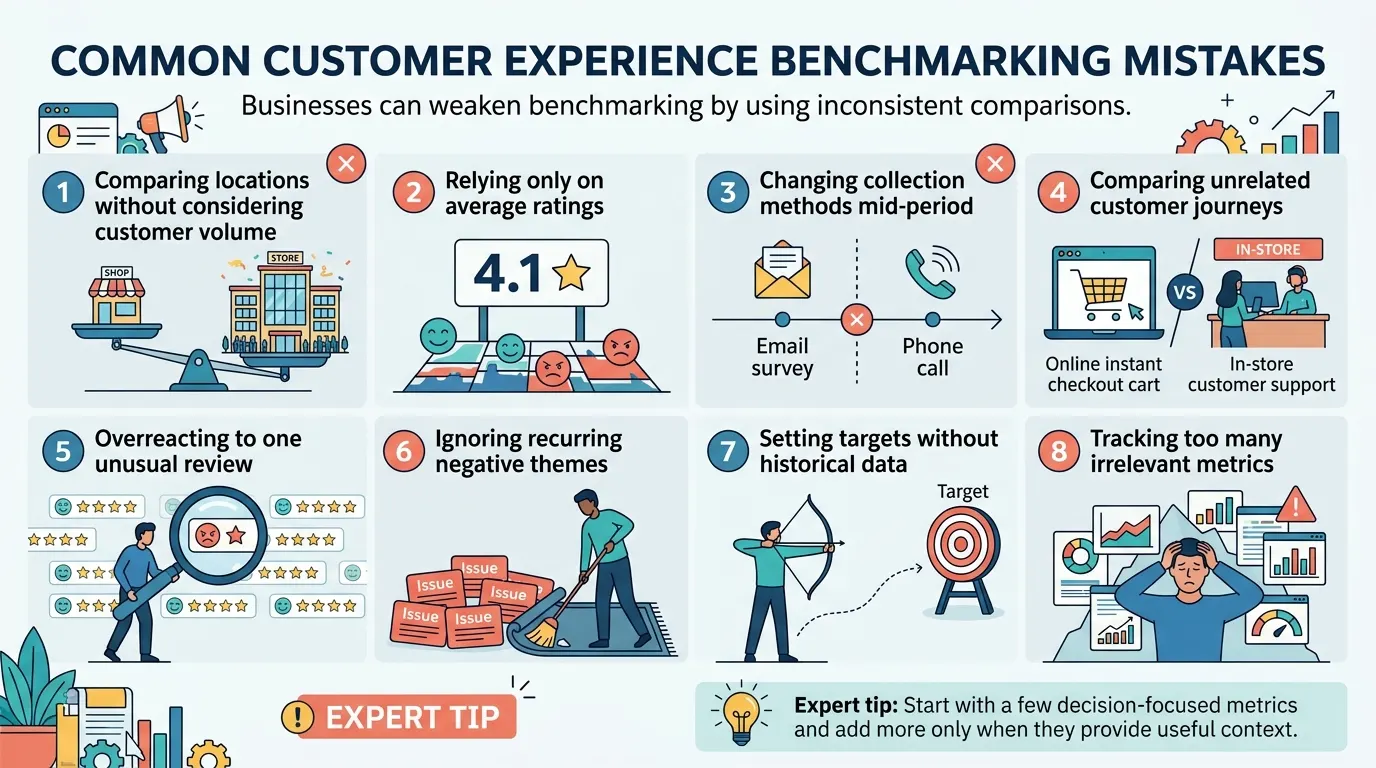
Common Customer Experience Benchmarking Mistakes
Businesses can weaken benchmarking by using inconsistent comparisons.
Avoid these mistakes:
Comparing locations without considering customer volume
Relying only on average ratings
Changing collection methods mid-period
Comparing unrelated customer journeys
Overreacting to one unusual review
Ignoring recurring negative themes
Setting targets without historical data
Tracking too many irrelevant metrics
Expert tip: Start with a few decision-focused metrics and add more only when they provide useful context.
What Should Businesses Check Before Choosing a SaaS Provider?
Businesses should choose a SaaS provider based on their actual benchmarking needs, not just its feature count.
Check whether it offers:
Customer data collection
Rating and sentiment monitoring
Location-level comparisons
Analytics and reporting
Reputation monitoring
Real-time alerts
Automation capabilities
Enterprise support
Suitable pricing limits
Trusted Optics provides a Collection tool, review management tools, Analytics dashboard Tool, Automation tool, and Enterprise Features.
Always verify that the platform meets your specific business requirements.
What About Integrations, Data Security, and Onboarding?
These factors matter when evaluating a SaaS provider, especially when replacing manual processes.
Check whether the platform supports your required systems, such as:
Accounting software
Payment gateways
WhatsApp
CRM and POS systems
Booking platforms
Confirm integration details, setup requirements, and additional costs rather than making assumptions.
Also evaluate data security, access controls, onboarding, migration, training, and implementation responsibilities before choosing a provider.
For Trusted Optics, no specific integration, security, onboarding, or migration claims are made because these details were not provided.
How Should Businesses Think About Pricing?
Pricing should be assessed against expected usage rather than looking only at the monthly figure.
Trusted Optics provides pricing plans through its pricing page, with different location and feedback limits.
Businesses should check:
Number of locations included
Monthly feedback limits
Annual versus other billing options
Additional location requirements
Enterprise requirements
Any costs associated with required services
A lower starting price is not necessarily better if the plan does not match the business's actual usage.
Who Is Customer Experience Benchmarking Not For?
Not every business needs a dedicated benchmarking process.
It may be unnecessary for a very small business with:
A simple customer journey
One location
Low interaction volume
Few customer touchpoints
No need for historical or location-level comparisons
In such cases, a simple review and feedback process may be enough.
Benchmarking becomes more valuable as customer interactions, locations, teams, and service complexity increase.
People Also Ask
What is Customer Experience Benchmarking?
It compares customer experience performance against a baseline, previous results, locations, or business targets.
Why is Customer Experience Benchmarking important?
It helps identify performance changes and areas needing improvement.
What metrics should businesses benchmark?
Common metrics include ratings, review volume, sentiment, feedback engagement, and negative review trends.
How does Voice of Customer Analytics support benchmarking?
It reveals customer opinions and recurring themes behind performance changes.
Final Takeaway
Customer Experience Benchmarking helps businesses track experience changes across locations and time. Combining ratings, sentiment, reviews, customer feedback, and analytics provides clearer insights for better decisions.
Trusted Optics offers collection tools, review management, analytics dashboards, automation, and enterprise capabilities to support CX measurement.
Contact Us to discuss your customer experience measurement needs.
Author Bio
Trusted Optics provides practical resources on customer experience, analytics, review management, and business insights to help organizations make informed decisions.
Written by
Alex Jones
Contributing writer sharing insights and expertise on customer experience and business growth.